
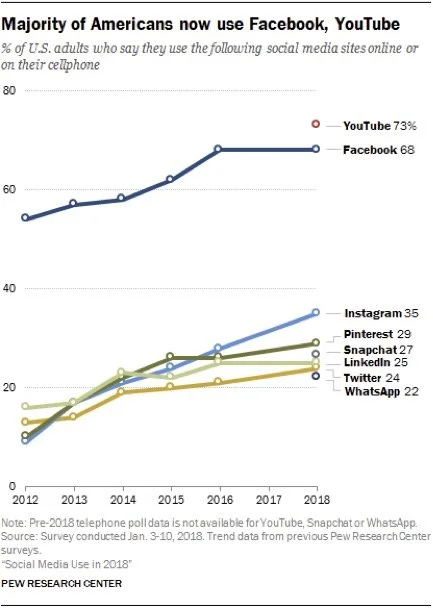
According to Facebook’s “Company Info: Stats” page, as of June of 2018, over two billion people were active members on Facebook, with nearly 1.5 billion people jumping onto the social media giant’s website each day. Facebook users are free (and encouraged) to post details of their daily lives and make commentary on the posts of others, generally. Many people have made Facebook an integral part of their daily routines (see graph below); apparently, it provides a social outlet that they find beneficial in many ways, personally. Moreover, according to the Pew Research Center, the vast majority of social media users are Millennials, ages 18–29 years old (Smith & Anderson, 2018, p. 4).
Of course, Facebook is just one of many social media outlets that people, worldwide, can utilize in postmodernity to promote social campaigns and movements dear to their hearts. Other social media companies include Twitter, Instagram, and Tumblr, and all of them—directly and indirectly—and claim to exist to serve and promote community within their membership. Not surprisingly, social media is often a powerful postmodern tool for public, political activism. Massey touches upon the personal aspect of activism in his textbook, highlighting a “dynamic confluence of personal efforts” that occurs in society (Massey, 2016, p. 2). Engler’s chapter, “The Act of Disruption,” also discusses the influence and repercussions of personal action, which can often lead to collective social changes, for better or for worse (Engler, pp. 145–153). Ironically, though, what seems to becoming more observable in these social media enclaves, rather than greater community bonds or positive social change, is an increase of narcissism and egotism on the part of members.
The possibility of narcissism (especially within the Millennial people-group) in social media involvement has not gone without notice in academia, even becoming an item of debate in the social sciences (Newman, 2018, p. 1). For instance, while Alloway, et al. suggest that, based on their 2014 study, Facebook (and presumably other groups like it) does not promote narcissism within its membership (Alloway, Runac, Quershi, & Kemp, 2014, p. 156), McCain and Campbell strongly assert the opposite, based on their 2016 investigation—“We now have relatively robust evidence that grandiose narcissism is associated with social networking behavior across many—but not all—conditions” (McCain & Campbell, 2016, p. 15). Firestone seems to affirm this conclusion in her own article, although simultaneously suggesting that narcissism is more about one’s home life than one’s online life (Firestone, 2012, p. 1)
The grander question can then be asked, how has this social media narcissism become a public social problem (and not just a private matter problem), and what can be done about it? To start, five areas of social media narcissism need to be addressed. First, social media narcissists are egocentric, lacking empathy and tending to think that no other view(s) matter besides their own. Second, their self-absorption promotes a disrespect for others’ opinions and perspectives. Third, they have delusions of grandeur and importance, acting as if they are experts on everything despite having no training in the field. Fourth, they cannot and will not tolerate any challenges or criticisms of their beliefs, regardless of any evidence. Finally, they demand constant affirmation and praise for their perspectives, assuming that any other response or dismissal is caused by bigotry, cruelty, and contempt. No doubt, other characteristics of social media narcissism can be ascertained; however, these five seem to be easily observable in many social media conversations, leading to broad community disharmony and division, depending upon the social media thread and spheres of engagement.
So, what can be done? Several options come to mind. First, each social media outlet could require new members to go through a short training program on netiquette (on how to communicate with each other politely on the Internet). Second, public schools could include a social media ethics class (or at least a module in a Social Studies course) that would instruct students on proper social parameters and foundations of Internet relationships. Third, parents could spend more quality Internet time with their children composing initial threads and responses, providing personal training in how to respond positively in a negative environment. Fourth, television networks could run public service announcements geared toward children and teens that promoted respect and kindness in social media relationships. Finally, social media outlets could hire “trainers” to talk with all members of threads flagged as hate speech, rather than just targeting one political group and excluding them.
The aforementioned discussion is not an exhaustive diagnosis, nor is it to be a cure for social media narcissism, but it could be a launching point for better social media relationships and social progress.
References
Alloway, T., Runac, R., Quershi, M., & Kemp, G. (2014). Is Facebook linked to selfishness? Investigating the relationships among social media use, empathy, and narcissism. Social Networking, 3(3), 150–158. DOI: dx/doi/org/10.4236/sn.2014.33020
Company info: Stats. (2018). Retrieved from https://newsroom.fb.com/company-info/.
Engler, M. & Engler, P. (2016). This is an uprising: How nonviolent revolt is shaping the twenty-first century. Nation Books.
Firestone, L. (2012). Is social media to blame for the rise in narcissism? Psychology Today. Retrieved from https://www.psychologytoday.com/us/blog/compassion-matters/201211/is-social-media-blame-the-rise-in-narcissism.
Massey, G. (2016). Ways of social change: Making sense of modern times. 2nd edition. Sage.
McClain, J. & Campbell, W. K. (2016). Narcissism and social media use: A meta-analytic review. Psychology of Popular Media Culture. DOI: dx.doi.org/10.1037/ppm0000137
Newman, K. (2018). The surprisingly boring truth about Millennials and narcissism. Greater Good Magazine. Retrieved from https://greatergood.berkeley.edu/article/item/the_surprisingly_boring_truth_about_millennials_and_narcissism.
Smith, A. & Anderson, M. (2018). Social media use in 2018. Pew Research Center. Retrieved from http://www.pewinternet.org/2018/03/01/social-media-use-in-2018/.
(Copyright by John S. Knox, 2026)